Wednesday, December 2, 2009

peanut butter and jelly bread


What a perfect combination!

This bread is not as sweet and rich as a peanut butter and jelly sandwich, but it is delightful because the bread itself has a warm, peanuty flavor. Also, the texture is almost like cake because of the egg.
_____________________________________________

Ingredients
1 egg, beaten
2 cups plus 2 Tbsp bread flour
2 Tbsp whole wheat flour
3/4 tsp table salt
1/4 tsp active yeast
1 cup plus 2 Tbsp cool water
3 Tbsp unsalted smooth peanut butter
1/4 cup unsalted dry-roasted peanuts, whole
1/4 cup unsalted dry-roasted peanuts, roughly chopped
1/3 seedless fruit jam of choice (I used raspberry preserves)
nonstick cooking spray

Directions
1. In a medium bowl, stir together the flours, salt, yeast, and the egg. Blend the water and peanut butter in a blender until smooth (some settling will occur fi this is left to stand, so blend just before using.) Add mixture tot he flour mixture and, using the wooden spoon or your hand, mix until you have a we, sticky dough without any lumps, about 30 seconds. Stir in the whole peanuts until evenly distributed. Cover the bowl and let sit at room temperature until the surface is dotted with bubbles and the dough is more than doubled in size, about 12 hours.

2. When the first rise is complete, sprinkle the surface of the dough with flour. Use a bowl scraper or rubber spatula to scrape the dough out of the bowl in one piece. Lightly flour your hands and gently pat and pull the dough into a rough rectangle about 8 by 12 inches.

3. Now you're going to make a sort of jelly roll: Position the dough so a long side is in front of you. Spread the jam evenly over the surface of the dough, leaving a 1-inch border on all sides. Lift up the far side of the rectangle and fold one third of it over toward the cetner, the continue rolling up the remainder into a cylinder. With the seam on the bottom, tuck the ends of the roll under to seal them, so the jam doesn't ooze out during baking.

4. Lightly coat the loaf pan with cooking spray. Sprinkle half of the chopped peanuts into the bottom of the pan. Gently transfer the dough, seam side down, to the loaf pan. Sprinkle the remaining chopped peanuts onto the dough. Cover the dough with a towel and place it in a warm, draft-free spot to rise for 1 hour. The dough is ready when it has doubled. If you gently poke it with your finger, it should hold the impression. If it springs back, let it rise for another 15 minutes.

5. About 15 minutes before the end of the second rise, preheat the oven to 450 degrees F, with a rack in the center.

6. Bake until golden, about 1 hour and 15 minutes. If the peanuts start to darken, loosely cover the loaf with foil. Use pot holders to invert the pan onto a rack, remove the pan, and turn the bread right side up to cool thoroughly. (Don't dawdle - the bread will get soggy if it cools in the pan.)

Friday, November 27, 2009

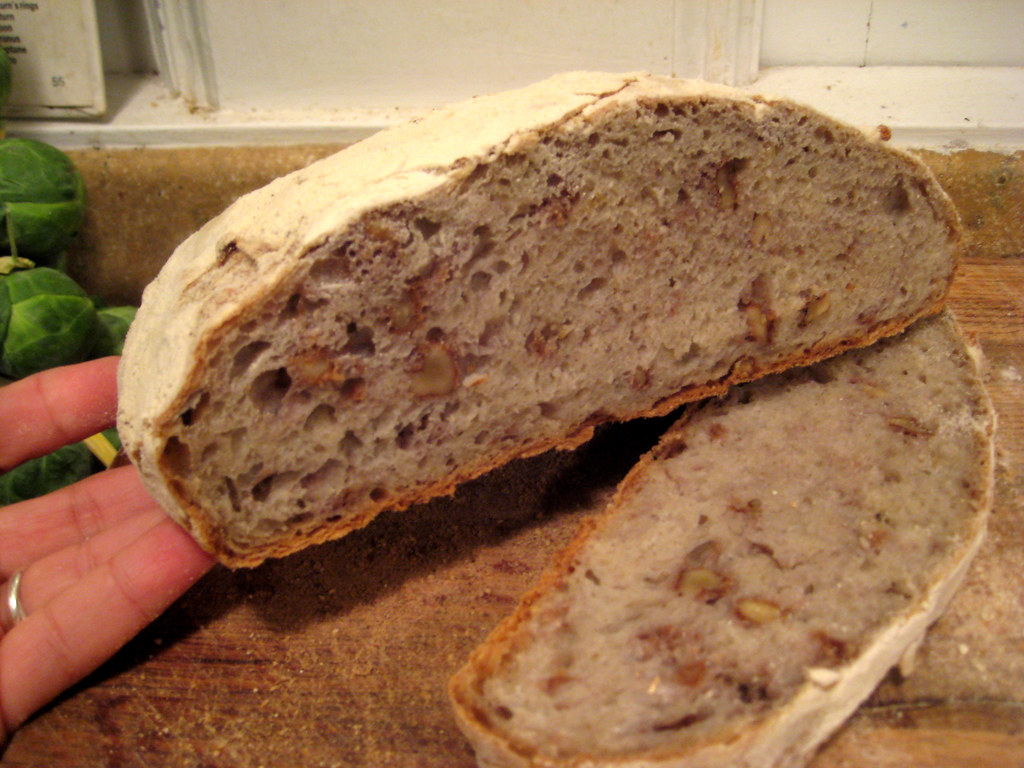
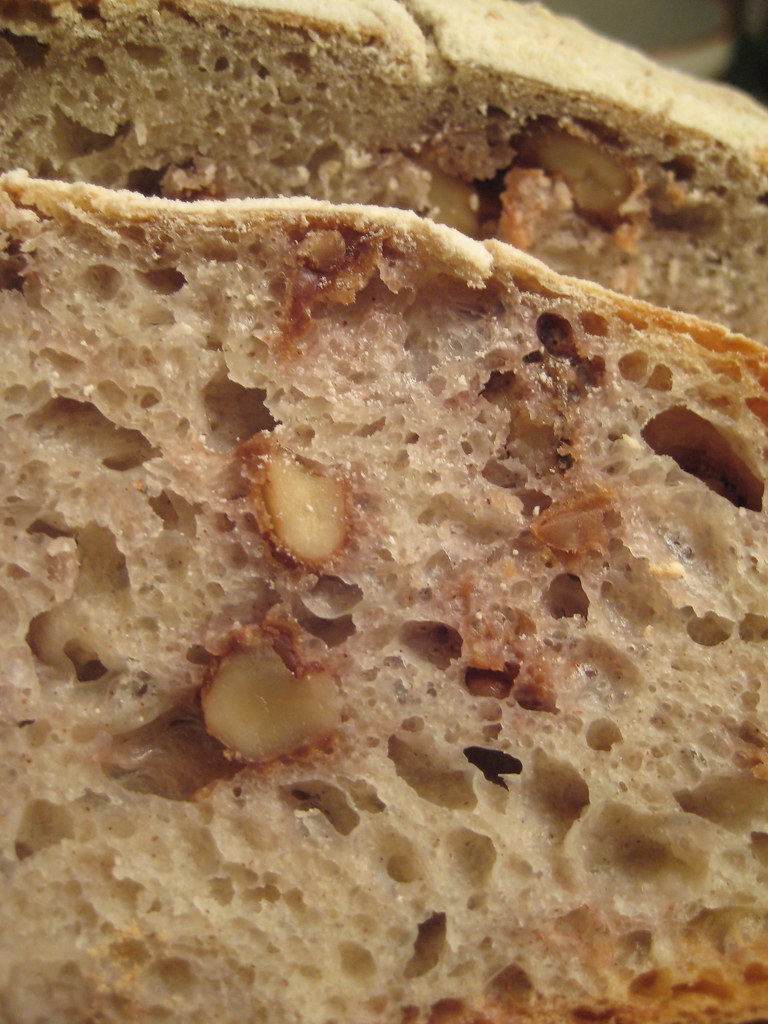
walnut cinnamon bread - pan co' santi


Walnuts and cinnamon make the bread perfect for winter! I am falling more and more in love with the no-knead method.

The beauty of the no-knead method, as Jim Lahey says in his book My Bread, The Revolutionary No-Work, No-Knead Method, is that it's so easy and it yields such amazing results because the bread creates the bonds needed for the structure by itself.

Jim Lahey says, "Applied in the modern home kitchen, it requires about 5 minutes of actual labor, followed by 12 to 18 hours in which the bread rises, developing structure and flavor on autopilot, and then another short rising time, and, finally, the brief baking in a covered pot. It's a terrific loaf of bread, easily within the reach of any home cook." I highly recommend trying this at home because it's beautiful, delicious, and very easy.

I have a QUESTION for bakers who read this. How do you feel about burnt loaves? I read a quote in Dan Lepard's The Handmade Loaf said by Johan Sorbergs, a baker in Stockholm, saying that "Today burnt crusts are viewed as deadly at worst... But without the penetrating effect of the browning and charring, the crumb flavor is thin." Is it true that to get a better crumb flavor the crust has to be nearly burnt?
____________________________________________
Yield: One 10-inch round loaf, 1 1/2 pounds
Equipment: A 4 1/2- to 5 1/2-quart heavy pot

Ingredients
3 cups bread flour
1/2 cup raisins
1/2 cup chopped walnuts
1 1/4 tsp table salt
3/4 tsp ground cinnamon
1/2 tsp active dry yeast
a pinch of freshly ground pepper
1 1/2 water, cool (~60 F)

Directions
1. In a medium bowl, stir together the flour, raisins, walnuts, salt, cinnamon, yeast, and pepper, mixing thoroughly. Add the water and, using a wooden spoon or your hand, mix until you have a wet, sticky dough, about 30 seconds. If it's not really sticky to the touch, mix in another tablespoon or two of water. Cover the bowl and let sit at room temperature until the surface is dotted with bubbles and the dough is more than doubled in size, 12 to 18 hours.

2. When the first rise is complete, generously dust a work surface with flour. Use a bowl scraper or rubber spatula to scrape the dough out of the bowl in one piece. Using lightly floured hands or a bowl scraper or spatula, lift the edges of the dough in toward the center. Nudge and tuck in the edges of the dough to make it round.

3. Place a tea towel on your work surface and generously dust it with wheat bran, cornmeal, or flour. Gently place the dough on the towel, seam side down. If the dough is tacky, dust the top lightly with wheat bran, cornmeal, or flour. Fold the ends of the tea towel loosely over the dough to cover it and place it in a warm, draft-free spot to rise for 1 to 2 hours. The dough is ready when it is almost doubled. If you gently poke it with your finger, it should hold the impression. If it springs back, let it rise for another 15 minutes.

4. Half an hour before the end of the second rise, preheat the oven to 475 degrees F, with a rack in the lower third, and place the covered 4 1/2- to 5 1/2-quart heavy pot in the center of the rack.

5. Using pot holders, carefully remove the preheated pot from the oven and uncover it. Unfold the tea towel and quickly but gently invert the dough into the pot, seam side up. (Use caution - the pot will be very hot) Cover the pot and bake for 30 minutes.

6. Remove the lid and continue baking until bread is a deep chestnut color but not burnt, 15 to 30 minutes more. Use a heatproof spatula or pot holders to gently lift the bread out of the pot and place it on a rack to cool thoroughly.

Tuesday, November 24, 2009

pain viennois/roscones colombianos


There is a Colombian pastry I really love called roscón. It is bread shaped like a donut that has guava paste inside and sugar sprinkled on top. I don't have the recipe for this (my grandmother Tuti is getting it for me, probably by exchanging it for the hottest gossip in town), so I made one up. I used the recipe for sweet bread, sometimes called pain viennois (from Richard Bertinet's Dough), and stuffed the bread with guava paste.

It is remarkably similar to the real thing.
_______________________________

Ingredients

4 cups bread flour
2 1/2 tsp instant yeast
1 tsp fine sea salt
2 2/3 caster (superfine) sugar
4 Tbsp unsalted butter
2 large eggs
1 cup whole milk, at room temperature

Directions

1. Whisk together the dry yeast and bread flour in a large, wide mixing bowl.  Add the salt and sugar and whisk in well.

2. Add the unsalted butter, cut into small cubes, then rub the butter into the flour mixture until well crumbled.

3. Add the eggs and milk, then mix together with a spatula until it forms a shaggy dough.  Cover with a tea towel and allow to rest for 10 minutes. Note that this recipe uses two eggs – the photo below was from a double batch.

4. Knead the dough until smooth.

5. Oil the scraped-out mixing bowl, then return the dough to the bowl, cover with clingfilm and allow to rise until doubled in size (about an hour).


6. Turn the dough onto a lightly floured surface and gently fold it onto itself. Divide the dough into five pieces, then shape each piece into a long roll. If you want, insert the jam or chocolate in the rolls and make sure none of it is sticking out. Make the rolls into rings. Place the dough on a tray lined with parchment paper, allowing room to spread.  Brush each roll with two coats of beaten egg, before making several deep cuts diagonally across the top with a razor or sharp knife.(I forgot to do this).  Preheat the oven to 350 F.

7. Allow the dough to prove for an hour longer, then bake in the preheated oven for 10 – 15 minutes, until dark golden brown.  The finished bread has a brioche-like quality and can be used for a variety of sweet and savoury applications

simplest no knead bread


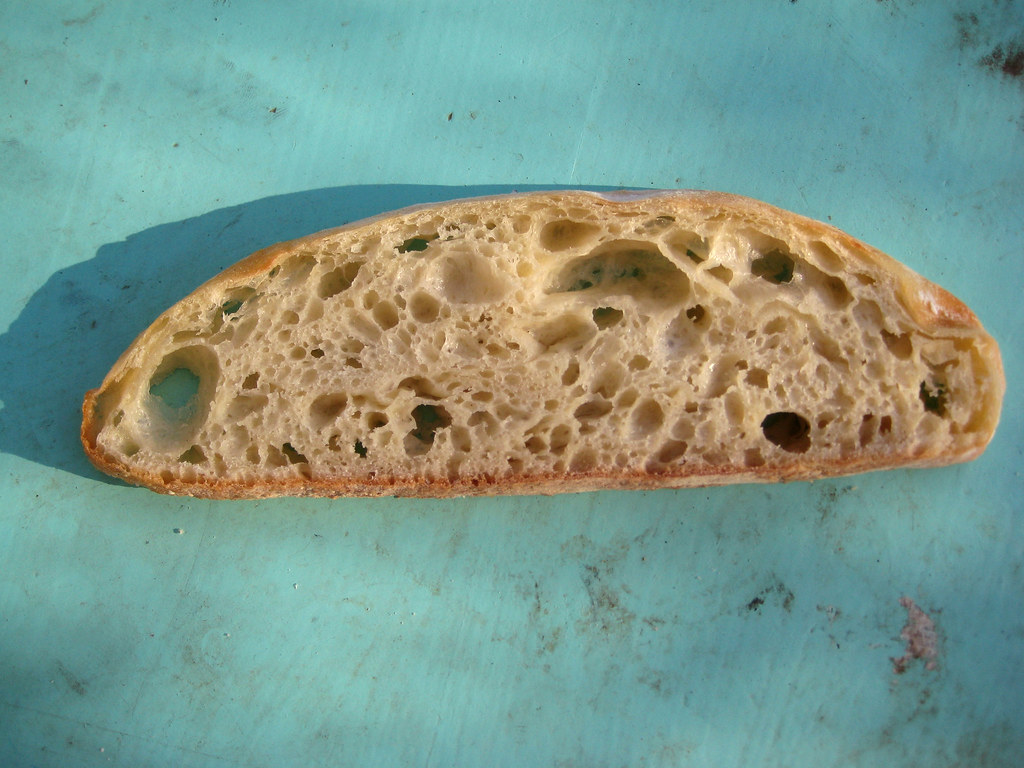
This recipe was made popular by the New York Times. They published it in 2006 and sparked a whole new generation of home artisan bakers. This bread is so easy to make and yields such great results that everyone was fascinated with it and started getting interested in more difficult recipes.

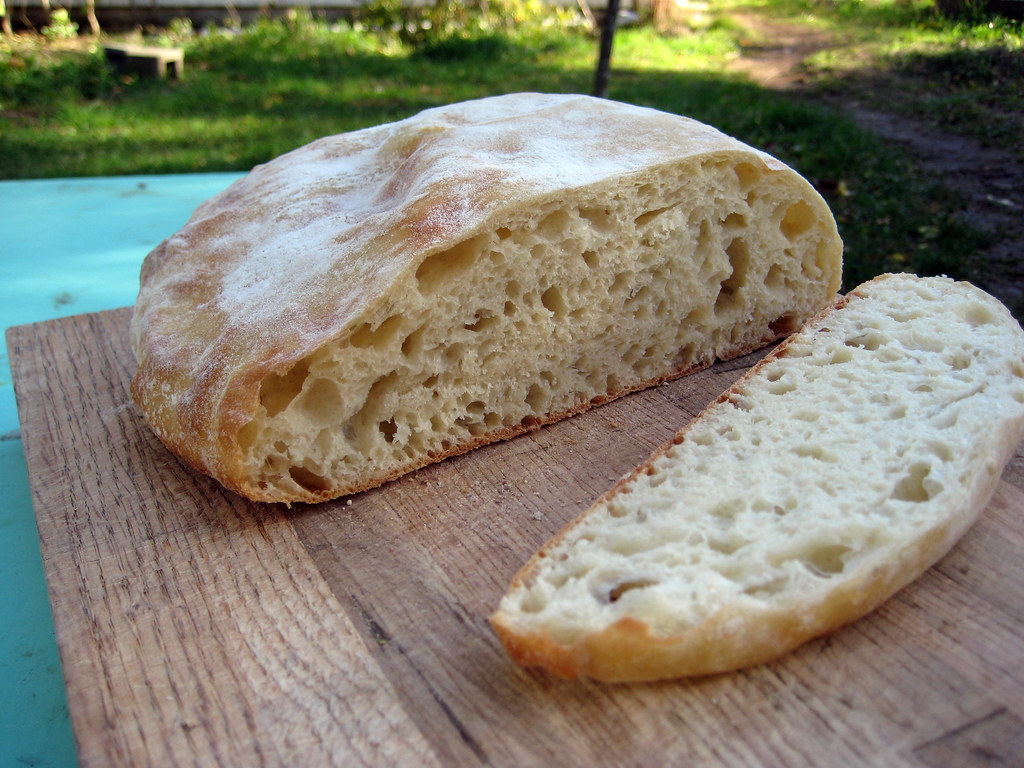
The crumb is really airy, has lots of bubbles, and it is very similar to Pugliese bread, which is my favorite to buy at the store and I've never managed to make right. Now I will never have to buy bread again!

I got the link from my friend Marta, and I'm so glad I know about it now! No kneading involved!
___________________________________

Adapted from Jim Lahey, Sullivan Street Bakery
Time: About 1½ hours plus 14 to 20 hours’ rising

Ingredients

3 cups all-purpose or bread flour, more for dusting
¼ teaspoon instant yeast
1¼ teaspoons salt
Cornmeal or wheat bran as needed.

Directions

1. In a large bowl combine flour, yeast and salt. Add 1 5/8 cups water, and stir until blended; dough will be shaggy and sticky. Cover bowl with plastic wrap. Let dough rest at least 12 hours, preferably about 18, at warm room temperature, about 70 degrees.

2. Dough is ready when its surface is dotted with bubbles. Lightly flour a work surface and place dough on it; sprinkle it with a little more flour and fold it over on itself once or twice. Cover loosely with plastic wrap and let rest about 15 minutes.

3. Using just enough flour to keep dough from sticking to work surface or to your fingers, gently and quickly shape dough into a ball. Generously coat a cotton towel (not terry cloth) with flour, wheat bran or cornmeal; put dough seam side down on towel and dust with more flour, bran or cornmeal. Cover with another cotton towel and let rise for about 2 hours. When it is ready, dough will be more than double in size and will not readily spring back when poked with a finger.

4. At least a half-hour before dough is ready, heat oven to 450 degrees. Put a 6- to 8-quart heavy covered pot (cast iron, enamel, Pyrex or ceramic) in oven as it heats. When dough is ready, carefully remove pot from oven. Slide your hand under towel and turn dough over into pot, seam side up; it may look like a mess, but that is O.K. Shake pan once or twice if dough is unevenly distributed; it will straighten out as it bakes. Cover with lid and bake 30 minutes, then remove lid and bake another 15 to 30 minutes, until loaf is beautifully browned. Cool on a rack.

Yield: One 1½-pound loaf.

Saturday, November 21, 2009

spelt bread


Spelt is a species of wheat that was used since the beginning of agriculture itself (~5000 years ago) in the Iberian Peninsula. It was then widely used in Europe in medieval times, and it recently became popular again as a health food. Spelt flour has a somewhat nuttier and slightly sweeter flavor than whole wheat flour. It contains more protein than wheat, and the protein in spelt is easier to digest. It is not gluten free, but some people who are allergic to wheat might be able to digest it.

I bought some spelt flour the other day and was testing it out. It's not such a drastic difference from whole wheat bread, but it is lighter and has a unique flavor that seems ideal for the winter.

I recommend you eat it with goat cheese and pomegranate seeds on top.
_______________________________________
Ingredients

1/2 Tbsp active dry yeast
1 cups warm water (105° to 110° F)
1 1/2 tablespoons honey
1 1/2 tablespoons melted butter
1 teaspoons sea salt
3 cups spelt flour (use any combination of whole or white spelt)

Directions

Combine the yeast, water and honey in a large warm bowl. Let stand for 10 minutes or until the yeast softens. Stir in the butter and salt and 3 cups of the flour. Stir vigorously with a wooden spoon. Add the remaining flour in increments until the dough becomes too stiff to stir, then place the dough on a lightly floured surface. Knead for about 6 minutes, adding any remaining flour as necessary, until the dough becomes smooth and elastic. Do not overknead.

Place the dough in a lightly greased bowl. Cover and let rise in a warm, draft-free spot for about 2 hours or until doubled in bulk.

Grease two 8 ½" x 4 ½" loaf pans. Punch the dough down to deflate it and divide it in half. Form each half into a smooth loaf and place in a prepared pan. Cover and let rise in a warm, draft-free spot for about 1 hour or until the dough has risen to the top of the pans.

Preheat the oven to 350° F.

Uncover the risen loaves. Place the pans on a heavy baking sheet and bake for 45 minutes or until the tops are light brown and crusty. Remove from the oven and tap out of the pan into the baking sheet. Turn the oven off and return the breads to the oven to crisp for 5 minutes. Remove from the oven and let cool on a wire rack.

Recipe by Rebecca Wood.

Friday, November 20, 2009

cranberry-nut-seed bread


I just made up this recipe. I think it's my favorite bread so far: whole wheat bread with cranberries, walnuts, pumpkin seeds, and flax seeds. It is great for winter because the walnuts give it a nutty warm, texture. Amazing.
_______________________________________

Ingredients

2 1/2 cups whole wheat flour
1 1/2 cups unbleached white bread flour
1/2 cup rolled oats
1/2 Tbsp instant yeast
2 tsp salt
1 Tbsp brown sugar
1/2 cup dry milk
1 egg
2 cups water, at room temperature

Seeds, etc.

1/4 cup chopped-up dried cranberries
1/8 cup chopped walnuts
1 Tbsp flax seeds
1 Tbsp pumpkin seeds

Directions

Mix the dry ingredients except salt and seeds etc., mix the wet ingredients. Combine wet and dry ingredients and mix with a wooden spoon until you get a ball of dough that comes off the sides of the bowl.

Put the seeds (not the cranberries) in a cup with boiling water. I've heard you're supposed to leave them in water overnight, but this worked just fine.

Knead for 10 mintues, by hand or machine, and then let rest in a bowl, covered with plastic, until doubled in volume.

Add salt and seeds, etc. Knead for 5 more minutes until everything is evenly distributed.

Preheat the oven at 450 degrees F for one hour.

Form dough into loaves, by using the business letter fold, and let rest for 90 minutes.

Put dough in oven, toss some water, and bake until golden brown.

Let cool.

Monday, November 16, 2009

pan de medianoche


This isn't me. It's my friend Rachel, and Paul is in the background.

I ran into this recipe randomly on the internet and thought it sounded great. I've probably had it in sandwiches before, but I can't remember. It is very aromatic and almost sweet. It would go well with Cuban sandwiches or at tea time with jam.
________________________________

Ingredients

4 1/2 cups flour
2 Tbsp yeast
2 cups water
8 cups milk
1 whole egg
1/2 little cup of anise extract
1 lemon and its peel
1 orange and its peel
2 tsp salt
1/4 cup sugar
1 whisked egg for eggwash

Directions

Mix the dry ingredients, mix the wet ingredients. Combine wet and dry ingredients and mix with a wooden spoon until you get a ball of dough that comes off the sides of the bowl.

Knead for 10 mintues, by hand or machine, and then let rest in a bowl, covered with plastic, until doubled in volume.

Preheat the oven at 400 degrees F for one hour.

Form dough into balls or loaves and let rest for 90 minutes.

Brush eggwash on the dough. Put dough in oven and bake until golden brown.

Let cool.

Sunday, November 15, 2009

simplest pita bread


I got this recipe from The Fresh Loaf. I had the best Greek food I've ever tried after taking the Physics GRE about a week ago. They served a giant pita bread for the whole table (~ 1.5 ft diameter) with delicious tzatziki sauce and hummus (these are much better fresh than if you buy them at the store, which is not always the case (... maybe I've just been to terrible Greek restaurants)). It was very satisfying to grab a piece of pita bread and guiltlessly dip it into these abundant sauces, so I decided to try making it myself.

It's exactly what you would expect from pita bread.
____________________________________

Makes 8 pitas

Ingredients

3 cups flour
1 1/2 tsp salt
1 Tbsp sugar or honey
2 tsp yeast
1 1/4 to 1 1/2 cups water, roughly at room temperature
2 tablespoons olive oil

Directions

Mix the yeast in with the flour, salt, and sugar. Add the olive oil and 1 1/4 cup water and stir together with a wooden spoon. All of the ingredients should form a ball. If some of the flour will not stick to the ball, add more water.

Once all of the ingredients form a ball, place the ball on a work surface, such as a cutting board, and knead the dough for approximately 10 minutes (or until your hands get tired). If you are using an electric mixer, mix it at low speed for 10 minutes.

When you are done kneading the dough, place it in a bowl that has been lightly coated with oil. Cover the bowl with plastic wrap and set aside to rise until it has doubled in size, approximately 90 minutes.
When it has doubled in size, punch the dough down to release some of the trapped gases and divide it into 8 pieces. Roll each piece into a ball, cover the balls with a damp kitchen towel, and let them rest for 20 minutes. This step allows the dough to relax so that it'll be easier to shape.

While the dough is resting, preheat the oven to 400 degrees. If you have a baking stone, put it in the oven to preheat as well. If you do not have a baking stone, turn a cookie sheet upside down and place it on the middle rack of the oven while you are preheating the oven. This will be the surface on which you bake your pitas.

After the dough has relaxed for 20 minutes, spread a light coating of flour on a work surface and place one of the balls of dough there. Sprinkle a little bit of flour on top of the dough and use a rolling pin or your hands to stretch and flatten the dough. You should be able to roll it out to between 1/8 and 1/4 inch thick. If the dough does not stretch sufficiently you can cover it with the damp towel and let it rest 5 to 10 minutes before trying again.

Open the oven and place as many pitas as you can fit on the hot baking surface. They should be baked through and puffy after 3 minutes.

Followers